VBC Monomer Compliance Documents: CAS/EINECS and Spec Checks
Direct answer. A compliance file for an electronic-grade vinylbenzyl chloride (VBC) monomer is acceptable only when five fields agree across every document in it: the CAS number, the EINECS/EC number, the isomer or grade designation, the declared inhibitor content, and the specification basis — meaning the test method, the units and the measurement temperature. If a buyer has to reconcile two different CAS numbers, or if a purity figure arrives without a stated basis, the file should go back to the supplier before a purchase order is raised. The checks below apply equally to 4-Vinylbenzyl chloride (CAS 1592-20-7), 2-Vinylbenzyl chloride (CAS 22570-84-9), 3-(Chloromethyl)styrene (CAS 39833-65-3) and mixed Vinylbenzyl chloride (CAS 30030-25-2).
The identity problem: one monomer family, four CAS entries
VBC documentation usually fails at the header, not at the drum. The family puts four commercial identifiers in front of a buyer, and each one describes a different article:
- 4-Vinylbenzyl chloride, CAS 1592-20-7 — the para isomer, offered as a pure grade (p-VBC ≥99% in the standard specification menu).
- 2-Vinylbenzyl chloride, CAS 22570-84-9 — the ortho isomer, which appears in the same catalogue as 1-(chloromethyl)-2-vinylbenzene and as a pure grade (o-VBC ≥98%).
- 3-(Chloromethyl)styrene, CAS 39833-65-3 — the meta isomer, catalogued as 1-(chloromethyl)-3-vinylbenzene and supplied as a pure grade (m-VBC ≥98%).
- Vinylbenzyl chloride, CAS 30030-25-2 — the mixed isomer grade, which can also be supplied in any custom o/m/p ratio.
The failure mode is quiet. A dossier can be internally consistent and still describe the wrong article: a mixed grade quoted under 30030-25-2 for a purchase order that specifies 1592-20-7 will pass a casual review, because both numbers are real and both belong to the same chemical family. It will not pass a formulation review, because a photoresist or membrane process qualified on a pure para grade is not interchangeable with a mixed isomer feed.
Decision rule: the CAS number printed on the purchase order line, the supplier invoice, the certificate of analysis header and the drum label must be one number. Not a pair, not a range, not an alternative separated by a slash.
Industry background: electronic grade is a documented grade
In electronic chemicals, the word "grade" describes an impurity envelope rather than a main-component assay. A photoresist monomer that is 99% pure but carries uncontrolled metal ions is not electronic grade; a monomer at a lower assay with a controlled and reproducible metal panel may be. That is why the document file, not the label, carries most of the qualification evidence.
The same definitional discipline applies one level up. Fortune Business Insights valued the global photoresist chemicals market at USD 38.00 billion in 2025 and projected USD 40.30 billion for 2026 across a 2026–2034 forecast window, while other research houses scope the same field far lower because they exclude solvents and developers from the definition. The number is not the point; the definition behind the number is. A buyer who accepts a headline market figure without checking its scope is making the same error as a buyer who accepts a COA without checking its basis.
The applications that consume these monomers set the documentation agenda. VBC is used as a core monomer for synthesising high-performance negative photoresist resins, including electron-beam photoresists; in advanced packaging dielectric materials; in homogeneous ion-exchange membranes, ultra-pure water resins and chelating resins; and as a dual-functional monomer that can be derivatised by chloride displacement and can serve as a starter for copolymer preparations. Each of those routes reads a different part of the file first.
The document set a VBC buyer should hold
Before evaluating any single field, confirm the file is complete. For a single isomer or mixed grade shipment, the minimum set is:
- Safety data sheet (SDS) in a language the receiving site can act on, with sections 1, 3 and 14 internally consistent.
- Certificate of analysis (COA) per batch, listing test items, methods and results, and carrying the same CAS and grade designation as the order.
- Technical data sheet (TDS) for the exact grade, including physical constants with their temperature basis and the inhibitor declaration.
- Regulatory and inventory statements naming the exact CAS and the destination market.
- Transport documents consistent with SDS section 14 and with the packaging actually used.
- Quality-system evidence — a certificate or audit report with a visible scope and expiry date.
- Batch linkage — a traceability code that connects drum, COA, packing list and retained sample.
Step-by-step: reading the file
Step 1 — Match the CAS and the EINECS/EC number as a pair
An EINECS number is a European registry identifier assigned to substances listed in the European Inventory of Existing Commercial Chemical Substances; in current usage the same identifier is cited as the EC number. It is not derived from the CAS number, and it cannot be safely inferred from it. That single fact is why the pair has to be checked rather than assumed.
Read section 1 of the SDS (identification) and section 3 (composition) and confirm they print the same CAS and the same EC number. Then confirm the COA header repeats that pair and that the commercial invoice matches the purchase order. Where a supplier's SDS prints one CAS for the substance and a second CAS in an impurity row, ask in writing which substance the shipment is — do not resolve it yourself. Where a quotation lists two CAS numbers as alternatives on one line, the quotation is not yet a specification.
Step 2 — Fix the isomer and the grade designation
Assay alone does not identify the article. The grade string on the COA should state the isomer purity separately from the total assay — for example a para grade at ≥99% p-VBC, an ortho grade at ≥98% o-VBC, a meta grade at ≥98% m-VBC, or a defined custom o/m/p mixture. If the COA says only "purity 99%" without naming the isomer basis, the document cannot be tied to a formulation that was qualified on a specific isomer.
Step 3 — Read the assay against its method and its basis
A purity number is only comparable when the method and the basis travel with it. Three questions close most of the gap:
- Method: was purity measured by GC or by HPLC, and is the result area-percent or weight-percent? Routine acceptance testing in this product family covers purity by GC/HPLC, moisture, appearance, colour, acid value and — for electronic grade — metal content.
- Basis: is the figure reported as-is, on an anhydrous basis, or excluding inhibitor? A 99% figure that excludes the inhibitor is not describing the same material as a 99% figure that includes it.
- Impurity panel: for electronic grade, the metal rows should be reported by ICP-MS with the elements named (sodium, iron and copper are the ones commonly specified for custom limits) and with the detection limit stated per element. Moisture should be reported by Karl Fischer. Particle data, where the end use requires it, should carry a size threshold.
A ppb-level claim printed without a method, an element list and a detection limit is a marketing sentence, not a specification. It may still be true; it is not yet verifiable.

Step 4 — Treat boiling point, density and refractive index as cross-checks
Physical constants are the part of a TDS that buyers skim and then never use. In practice they do three jobs in a compliance review:
- Boiling point sets the boundary for vacuum transfer, distillation and degassing steps. A value quoted at atmospheric pressure does not describe vacuum behaviour unless the pressure is stated with it.
- Density converts mass to volume for reactor charging and drum inventory, and gives a fast sanity check: a density outside the expected window for the declared isomer usually means the wrong grade or a hydrolysed sample.
- Refractive index — written with its measurement basis, for example n20/D, meaning 20 °C and the sodium D line — is a quick incoming fingerprint test that costs minutes and catches mislabelled containers.
All three shift with isomer, purity, inhibitor level and temperature. This guide deliberately does not print numeric values for the VBC isomers: a constant copied from a generic reference into a purchase specification is worse than no constant at all, because it will be enforced. Request the TDS for the exact grade, record the temperature basis, and compare it with your own incoming measurement before writing the figure into an internal specification.
Step 5 — Read the inhibitor declaration as a specification field
VBC is a polymerisable monomer, so an inhibitor is normally declared. Where a grade carries a declared inhibitor — such as 0.1% TBC (tert-butylcatechol) on the 3-isomer — that figure has to appear identically in three places: SDS section 3, the COA, and the package label. A file where the SDS says one level and the COA says another is a file that has not been reconciled after a formulation change.
Two follow-up questions belong in the same email. First, is the assay measured with or without the inhibitor? Second, what storage and headspace conditions does the supplier assume when it states an inhibitor level, since an inhibitor is consumed over time and under shear? "Inhibited" and "kept cold" are different controls, and the SDS should say which one applies to the grade you are buying.
Step 6 — Regional expectations: request a statement, do not assume a rule
Documentation obligations follow the substance, its concentration, the destination market and the declared end use. No generic list replaces a written statement for the exact CAS, and the final authority is the importer of record together with the destination regulator. What a procurement team can do is ask in the right categories and read the answers.
- Substance identity and inventory status. Ask for a dated, substance-specific statement of registration or inventory status for the destination market — for example EU REACH registration status and CLP classification, or US TSCA inventory status — naming the exact CAS, not the product family.
- SDS language and classification. The receiving site's EHS team has to be able to act on the document, which means a version in a language they use, with the classification and labelling fields populated.
- Transport consistency. Section 14 of the SDS, the dangerous goods declaration, the booking and the packaging specification have to agree. UN-certified dangerous goods packaging is available on request for this product family, and temperature-controlled container options exist for VBC on long-haul routes; both should appear as named options on the quotation rather than as assumptions.
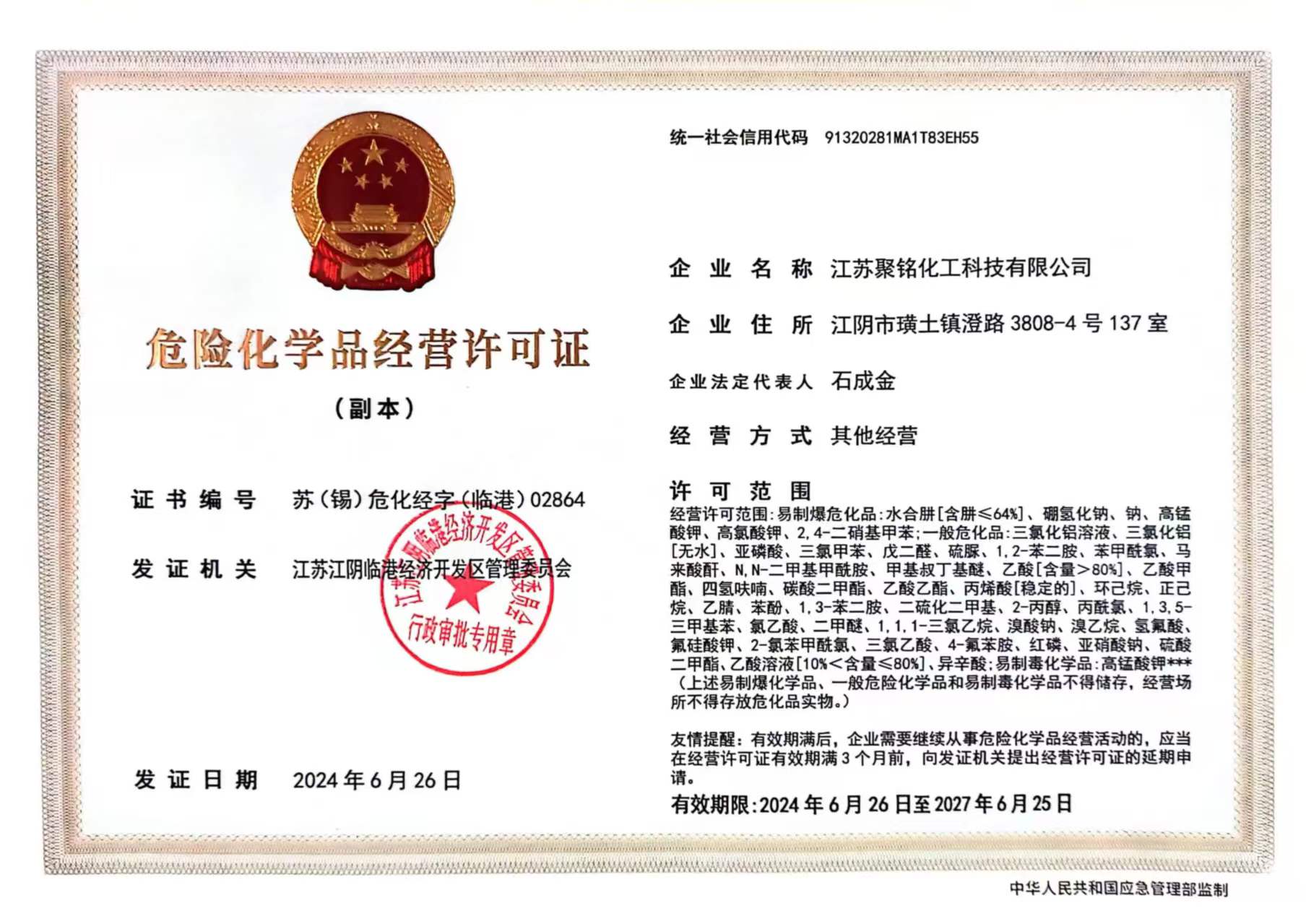
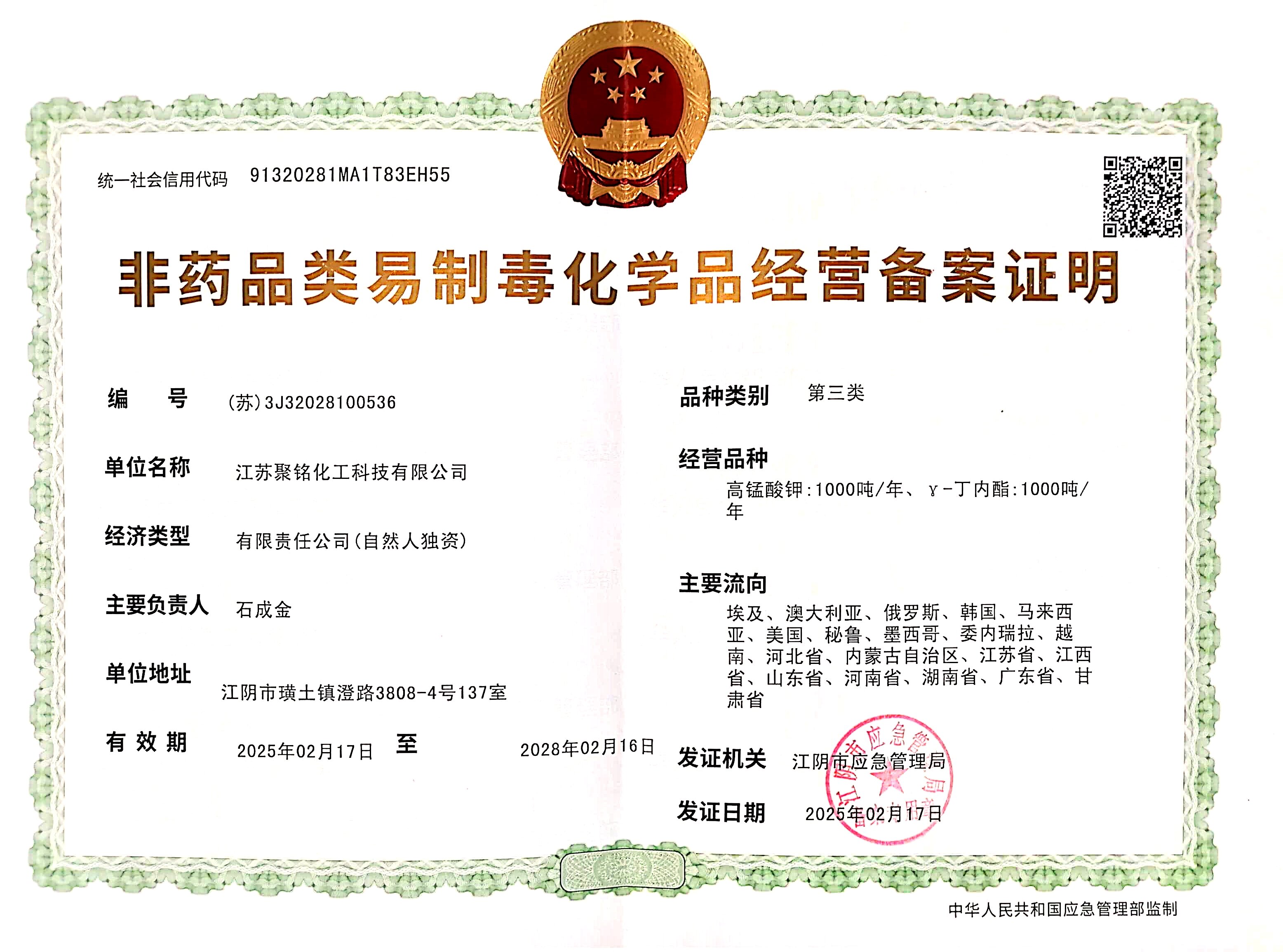
- China-side operational licences. The supplier's own file should be checkable here too. Jiangsu Juming Chemical Technology Co., Ltd. holds a Hazardous Chemicals Operation License (Su(Xi)WHJJZ(Lingang)02864, issued 2024-06-26, valid to 2027-06-25) whose stated scope is the sale of hazardous chemicals within the permitted scope, excluding storage, and a Non-pharmaceutical Precursor Chemicals Filing Certificate ((Su) 3J32028100536, issued 2025-02-17, valid to 2028-02-16) covering business operation of Category III non-pharmaceutical precursor chemicals. Whether a particular CAS falls inside either scope is a written question to the supplier, not something to infer from a certificate title.
- Destination entry. Confirm who is the importer of record, what customs classification is being declared, and whether any destination-side permit or notification applies before the shipment leaves.
Step 7 — Check validity, scope and version control
Every certificate in a supplier file carries three fields that buyers skip: issue date, expiry date and scope. Skipping them is how an expired audit gets filed as current evidence.
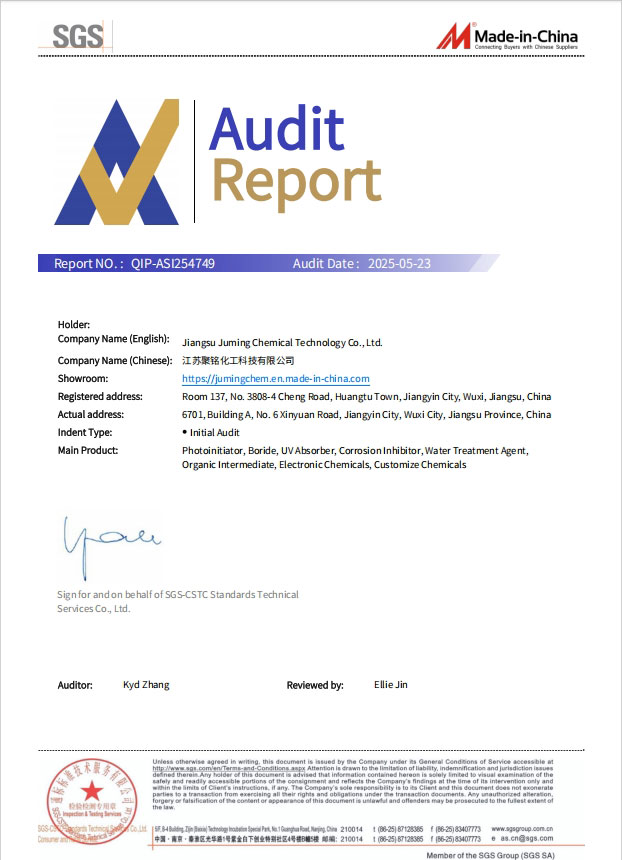
Two examples from a real file make the point. An ISO 9001 certificate (NOA2505548, issued 2025-07-25, valid to 2028-07-24) is only meaningful within the scope it declares. An SGS factory audit report (QIP-ASI254749, issued 2025-05-23) carries an expiry of 2026-05-23, so an evaluation carried out in the second half of 2026 should request the current audit cycle rather than cite the earlier report as present-day evidence. Neither document is defective; both are simply time-stamped, and a file that hides the timestamp is the problem.
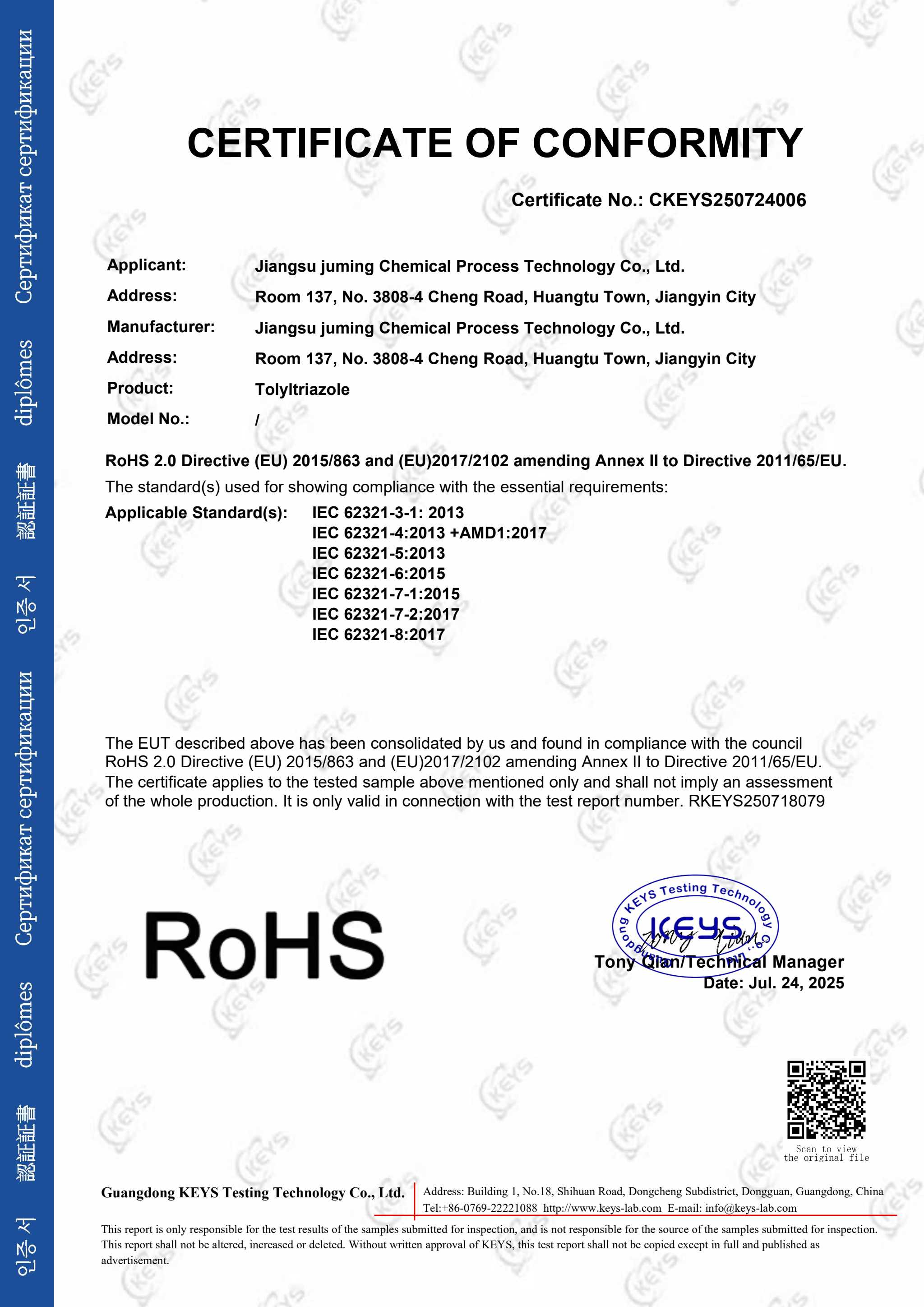
Scope behaves the same way. A restricted-substance certificate (for example CKEYS250724006, issued 2025-07-24) that is declared for one named product does not cover the whole electronic-grade catalogue. When a supplier sends a certificate, read the scope line before the logo.
Version control closes the loop. Ask for the SDS revision number and date, the COA for the actual shipping batch rather than a representative batch, and a contractual change-notification clause covering formulation, inhibitor level, analytical method and packaging.
What each end use adds to the document list
Negative photoresist resins, including 193 nm immersion and 248 nm processes
Metal ions dominate. In a referenced project with a photoresist formulator, metal impurities were held below 10 ppb, meeting SEMI Grade 4 standards, and the work helped the customer pass verification with a top-tier Korean wafer fab and move to mass production. That is a documented project result, not a standing certificate for every batch. The documents to request in this segment are the element-by-element ICP-MS panel with detection limits, the batch trend rather than a single point, moisture data, and particle counts against the threshold your coating line can tolerate.
Homogeneous ion-exchange membranes and ultra-pure water resins
The monomer's value here is dual-functional: it can be derivatised by chloride displacement and can act as a starter for copolymer preparations. Documentation therefore has to demonstrate that the reactive chlorine content and the isomer ratio are controlled, because functionalisation yield depends on both. Ask how the supplier reports those two quantities on the COA and whether the reporting method has changed within the supply history.
Advanced packaging dielectric materials
Moisture and hydrolysis control decide whether the document is usable. The material must be handled under extremely dry and sealed conditions to prevent moisture-induced hydrolysis, and polymerisation is recommended under inert gas protection in anhydrous polar solvents such as NMP or DMAc. The file should therefore carry a moisture specification, a packaging-integrity description, storage temperature and shipping conditions, and a handling statement that matches your own SOP word for word. Where the shipping route crosses a hot climate, the temperature-controlled option belongs in the quotation, not in a footnote.
Comparison tables for the file review
| Document | What it establishes | What it does not establish |
|---|---|---|
| SDS | Identity, classification, composition ranges, transport information | Batch-specific purity or metal content |
| COA | Results for one batch against named methods | Consistency across batches, or suitability for your process |
| TDS | Grade-specific physical constants, inhibitor level, handling | Actual measured values for the drum you receive |
| Registration or inventory statement | Status of the named CAS in a named market on a stated date | Fitness for your specific end use |
| ISO 9001 certificate or audit report | A quality system within a declared scope and validity period | Product-level impurity performance |
| Restricted-substance test report | Compliance of the specific product named in the scope | Coverage of the rest of the catalogue |
| Product | CAS | Field to verify in the file |
|---|---|---|
| 4-Vinylbenzyl chloride | 1592-20-7 | EC/EINECS pair in SDS sections 1 and 3; para-isomer purity row; metal panel by ICP-MS |
| 2-Vinylbenzyl chloride (1-(chloromethyl)-2-vinylbenzene) | 22570-84-9 | Ortho-isomer designation; consistency of synonym use across SDS, COA and label |
| 3-(Chloromethyl)styrene (1-(chloromethyl)-3-vinylbenzene) | 39833-65-3 | Meta-isomer designation; declared inhibitor level (0.1% TBC) in SDS, COA and label |
| Vinylbenzyl chloride (mixed grade) | 30030-25-2 | Whether the order is a mixed grade or a single isomer; o/m/p ratio if a custom mixture |
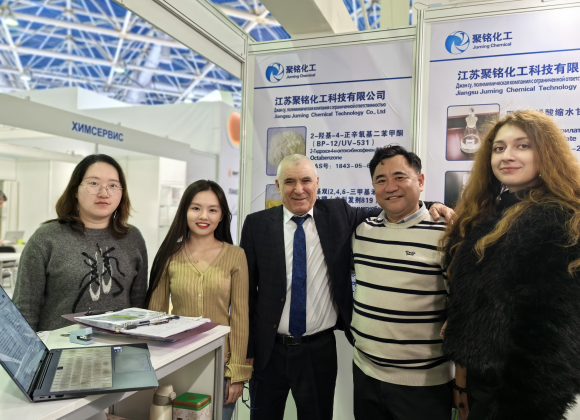
Where Jumingchem sits in this file
Jiangsu Juming Chemical Technology Co., Ltd. (Jumingchem) is a Chinese manufacturer of electronic-grade chemicals, established in 2017 and based in Jiangyin, Wuxi City, Jiangsu. Its electronic-grade range includes 5-Methyl-1H-benzotriazole (CAS 136-85-6), the four vinylbenzyl chloride entries above, and BPADA (CAS 38103-06-9), and the company states an ISO 9001 quality management system, GMP workshops, and ICP-MS, HPLC and GC testing as part of its quality control.
For a compliance reviewer, three capability statements are worth testing against documents rather than accepting at face value. The company reports ppb-level metal-ion purification capability — a claim that should be validated with a product-specific COA carrying methods and detection limits, exactly as described in Step 3. It reports microchannel and continuous-flow production for difficult chemistries, which is relevant to batch-to-batch consistency and should be reflected in COA trend data. And it offers custom work from process development through pilot scale-up to commercial production, with purity grade, isomer composition, packaging and documentation all treated as configurable fields — COA test items and format, SDS language, custom labels and third-party testing can be specified at order stage. The company's full product and capability overview is published at Jiangsu Juming Chemical Technology Co., Ltd..
FAQ
What should a custom electronic-grade chemicals OEM manufacturer provide with a VBC monomer order?
At minimum: an identification sheet pairing the CAS and EINECS/EC numbers; an SDS in the receiving site's language; a batch COA listing test items, methods and detection limits; a TDS for the exact grade with physical constants and the inhibitor declaration; transport documents consistent with SDS section 14; quality-system evidence with a visible scope and expiry; and a dated statement of registration or inventory status for the destination market. A batch traceability code that links drum, COA, packing list and retained sample completes the set.
How do I confirm that the CAS number on a COA matches the isomer I ordered?
Compare four places: the purchase order line, the supplier invoice, the drum label and the COA header. Then read the grade row, because a matching CAS with an unstated isomer basis still fails. If the order specifies 1592-20-7 and any document shows 30030-25-2, or lists both as alternatives, stop and request written confirmation of the shipping grade before release.
Can purity grade, metal-ion limits and isomer composition be customized?
Yes. The standard menu covers industrial grade, high purity grade and electronic grade with ppb-level metal ions, with metal content controlled to customer specification for elements such as sodium, iron and copper. Isomer composition can be supplied as pure para (≥99% p-VBC), pure ortho (≥98% o-VBC), pure meta (≥98% m-VBC) or any custom o/m/p ratio. Packaging runs from 1 kg to tons, including 25 kg HDPE drums, 200 kg steel-plastic composite drums and 1000 L IBCs for liquids.
What are the sample and minimum order terms?
The minimum order quantity is 1 kg. Pre-shipment sample confirmation is offered to new customers before mass production, and in the project referenced earlier the first validation sample was delivered within two weeks. Payment terms include T/T, D/P, Western Union and PayPal, and a third-party report from SGS, BV or Intertek can be arranged where the qualification file requires external testing.
What lead time applies to a customized monomer order?
Standard lead time is 7 to 30 days, and custom OEM work has been delivered within six weeks in the referenced project, supported by a 72-hour emergency order response mechanism. Sea freight from Shanghai or Ningbo takes roughly 15 to 35 days with a temperature-controlled container option for VBC, air freight 5 to 7 working days, and express 3 to 5 working days for samples. If you are assembling a documentation pack for an upcoming qualification, you can request the sample and the current file together through Jumingchem so that the COA, SDS and TDS arrive with the material rather than after it.
Conclusion
Compliance review of an electronic-grade VBC monomer is a five-field exercise repeated across every document: CAS, EINECS/EC, isomer or grade, inhibitor declaration, and specification basis. When those five agree, the physical constants become useful cross-checks, the transport papers match the booking, and the certificates can be read for scope and validity instead of for logos. When they disagree, the disagreement is the finding — and it is cheaper to find it in a PDF than in a reactor.
Two habits carry most of the value. Ask for statements that name the exact CAS and carry a date, and treat every capability claim as a hypothesis to be tested against a batch document. A supplier that can answer those requests in writing is a supplier whose file will survive a customer audit.
For the full product and grade list behind these documents, download the Jiangsu Juming Chemical Technology catalogue (PDF).
Have Questions or Need More Details?
Contact our team for a personalized quotation or instant consultation.
Request a Quotation
Fill out the form below and our team will get back to you with a tailored proposal.
WhatsApp Direct Chat
Prefer to chat in real-time? Message us on WhatsApp for instant assistance & quick answers.
- Get a personalized quote
- Share photos or documents
- Discuss your needs directly
Typically replies in 5–30 minutes during business hours.