Electronic-Grade Chemicals Compliance Guide: Vinylbenzyl Chloride Certifications & Regional Rules
Electronic-Grade Chemicals Compliance Guide: Vinylbenzyl Chloride Certifications & Regional Rules
The rule that resolves most problems: in electronic-grade vinylbenzyl chloride purchasing, the CAS number — not the product name — is the primary key. Four commercially traded “vinylbenzyl chloride” identities exist: CAS 1592-20-7 (EINECS 216-471-2), CAS 22570-84-9 (EINECS 245-092-5), CAS 39833-65-3 (EINECS 254-649-1) and CAS 30030-25-2 (EINECS 250-005-9). All four share the molecular formula C9H9Cl and a molecular weight of 152.62 g/mol. A certificate, a COA or a safety data sheet is only evidence for the substance it actually names.
This guide is a working procedure for buyers evaluating and then executing orders for electronic-grade chemicals, using vinylbenzyl chloride (VBC) isomers and related electronic-grade materials as the worked example. It sets out the documentation chain, the parameters that make a certificate checkable, the stabilizer and storage variables that change with the isomer, and the reason a documentation set must be assembled per destination market rather than copied between regions.
Jiangsu Juming Chemical Technology Co., Ltd. (Jumingchem) is a producer and supplier of electronic chemicals established in 2017 in Jiangsu Province, China. Its registered product list includes 5-Methyl-1H-benzotriazole (CAS 136-85-6), 4-Vinylbenzyl chloride (CAS 1592-20-7), 1-(chloromethyl)-2-vinylbenzene (CAS 22570-84-9), 1-(chloromethyl)-3-vinylbenzene (CAS 39833-65-3), Vinylbenzyl chloride (CAS 30030-25-2) and 4,4'-(4,4'-Isopropylidenediphenoxy)diphthalic anhydride / BPADA (CAS 38103-06-9). Its documentation set is used below as a concrete reference for what a buyer can request. Website: en.jmchemchina.com.
Why Vinylbenzyl Chloride Compliance Files Fail Review
Most compliance failures in electronic-grade VBC purchasing do not come from a missing document. They come from a document that is genuine, current and issued against a different substance than the one being bought.
The root cause is naming. “Vinylbenzyl chloride”, “chloromethylstyrene” and “VBC” are used commercially as umbrella terms. The mixed commercial grade is registered as CAS 30030-25-2, described as a mixture of 3- and 4-isomers containing 50–100 ppm tert-butylcatechol (TBC) as inhibitor. The single-isomer products are registered separately: 4-Vinylbenzyl chloride is CAS 1592-20-7, 1-(chloromethyl)-2-vinylbenzene is CAS 22570-84-9, and 1-(chloromethyl)-3-vinylbenzene is CAS 39833-65-3. A purchase specification that lists only “VBC” plus a purity figure leaves the receiving lab unable to tell which of the four registered entries will actually arrive in the drum.
Three further failure modes follow from the same root cause:
- Scope mismatch. A certificate whose recorded scope names one product is presented as covering a whole family.
- Validity drift. A certificate that has passed its expiry date is still circulating in a supplier's PDF pack.
- Regional reuse. A documentation set assembled for one destination market is reused unchanged for another, where the required evidence differs.
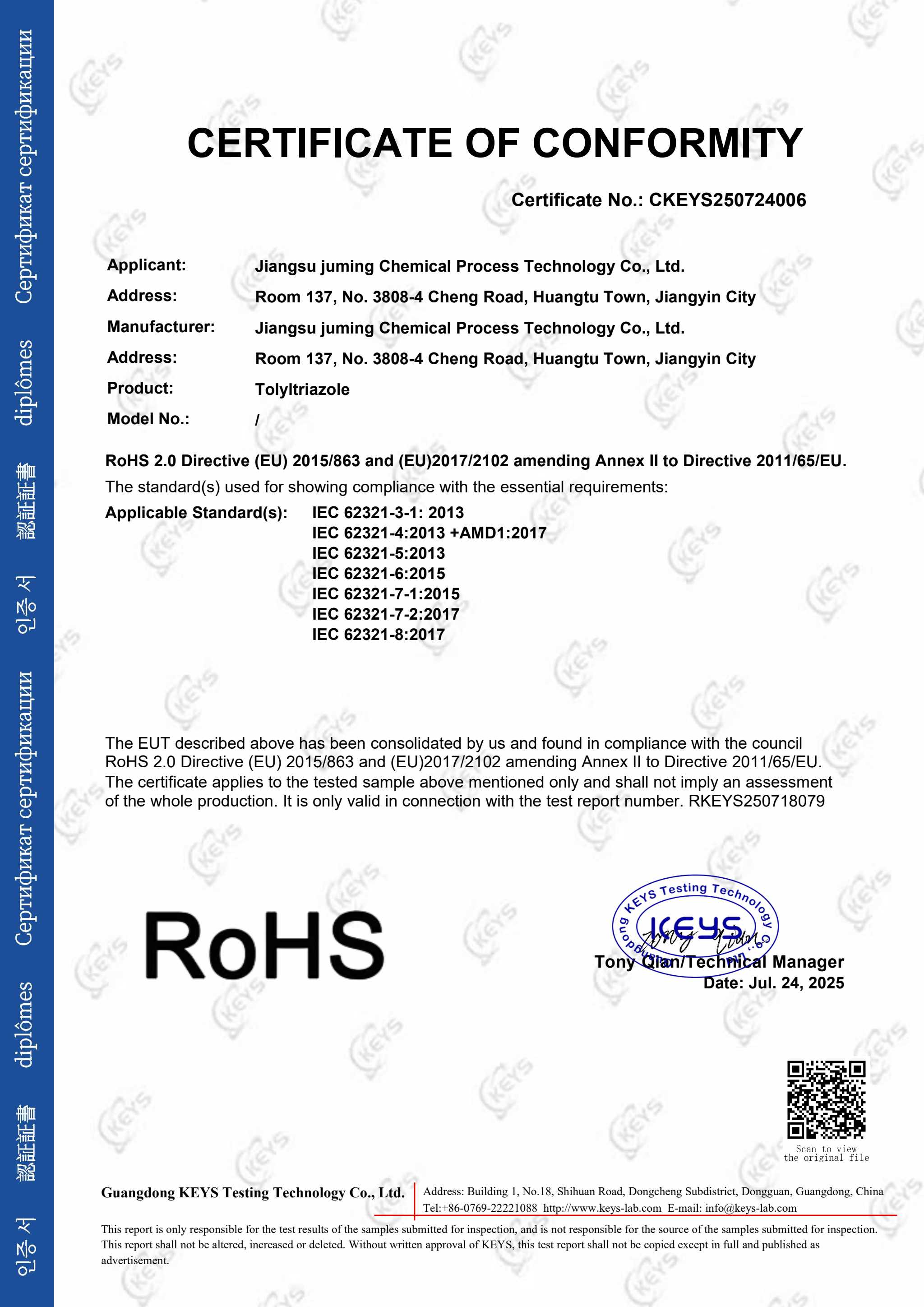
A worked example of scope. Jumingchem holds a RoHS Environmental Protection Compliance certification (number CKEYS250724006, issued 24 July 2025 by Guangdong KEYS Testing Technology Co., Ltd., referencing the RoHS 2.0 Directive (EU) 2015/863 and (EU) 2017/2102 amending Annex II to Directive 2011/65/EU). The recorded scope of that certificate is Tolyltriazole. It therefore evidences RoHS compliance for Tolyltriazole — a corrosion-inhibitor product in the same catalogue — and does not on its own evidence RoHS compliance for a VBC isomer. Buyers who request “your RoHS certificate” and file whatever arrives are filing the wrong document against the wrong substance.
Industry Background: Why Documentation Intensity Keeps Rising
Electronic-grade chemicals sit at the front of the semiconductor and advanced-materials supply chain, which is why documentation intensity there is higher than in general industrial chemistry. Published market estimates give the scale of that chain, and also illustrate a discipline point that matters when reading compliance files.
- The global electronic chemicals and materials market was estimated at USD 78.5 billion in 2025 (Grand View Research).
- Global semiconductor materials market revenue reached USD 73.2 billion in 2025 (SEMI).
- The electronic-grade photoresist market was estimated at USD 4.96 billion in 2024 (Grand View Research).
- The global corrosion inhibitors market was estimated at USD 8.79 billion in 2024 (Market Research Future).
- Asia Pacific accounted for 66.6% of electronic materials and chemicals market revenue in 2025 (Grand View Research).
Those figures are not internally consistent across sources, and that is the point. For the same period, Fortune Business Insights published USD 75.6 billion for 2025 while Grand View Research published USD 78.5 billion, and SEMI reported USD 67.5 billion for 2024, because the scopes differ on whether substrates and hardware-linked materials are included. A compliance or procurement file that quotes a market number should therefore carry the source name and the year. Two documents quoting different totals are not automatically in conflict.
Within this chain, VBC is a monomer rather than a finished material. It is used as a core monomer for synthesising high-performance negative photoresist resins, including electron-beam photoresists, and in advanced packaging dielectric materials. It is also used for manufacturing homogeneous ion-exchange membranes, ultra-pure water resins and chelating resins. Because the monomer is consumed inside a customer's formulation, the buyer's compliance question is not only “is this material legal to import” but “can I prove, batch by batch, that what entered my process is the substance I specified”.
The Substance Identity Map: Four Registered Identities, One Molecular Formula
All four registered VBC identities share the molecular formula C9H9Cl and a molecular weight of 152.62 g/mol. That shared formula is exactly why the CAS number, and not the chemical name or the formula, must be the primary key on every document in the file.
| Product name | CAS number | EINECS number | Molecular formula | Molecular weight |
|---|---|---|---|---|
| 4-Vinylbenzyl chloride | 1592-20-7 | 216-471-2 | C9H9Cl | 152.62 g/mol |
| 1-(chloromethyl)-2-vinylbenzene (2-Vinylbenzyl chloride) | 22570-84-9 | 245-092-5 | C9H9Cl | 152.62 g/mol |
| 1-(chloromethyl)-3-vinylbenzene (3-(Chloromethyl)styrene) | 39833-65-3 | 254-649-1 | C9H9Cl | 152.62 g/mol (listed as 152.62076) |
| Vinylbenzyl chloride (mixture of 3- and 4-isomers) | 30030-25-2 | 250-005-9 | C9H9Cl | 152.62 g/mol |
Two practical consequences follow. First, a COA that reports “C9H9Cl, MW 152.62” is consistent with all four identities and therefore distinguishes none of them; the CAS number must appear on the same line as the result. Second, the isomer-specific physics differ, which is why “VBC” cannot be treated as a single line item in a logistics file: the para product is recorded with a boiling point of 229 °C (lit.) and a density of 1.083 g/mL at 25 °C, while the ortho product is recorded with a predicted boiling point of 223.4 ± 9.0 °C and a predicted density of 1.066 ± 0.06 g/cm³.
What a Complete Documentation Set Contains
An electronic-grade VBC documentation set has three layers — supplier-level authorizations, substance-level certificates, and batch-level records — and the three are not interchangeable. A supplier authorization proves the company may trade; it does not prove the substance complies. A substance-level certificate proves compliance for a named substance; it does not prove the batch that shipped is that substance. Only batch-level records close that last gap.
Layer 1 — Supplier authorizations
| Document | Certificate number | Issuing body / standard referenced | Scope as recorded | Issue / validity as recorded |
|---|---|---|---|---|
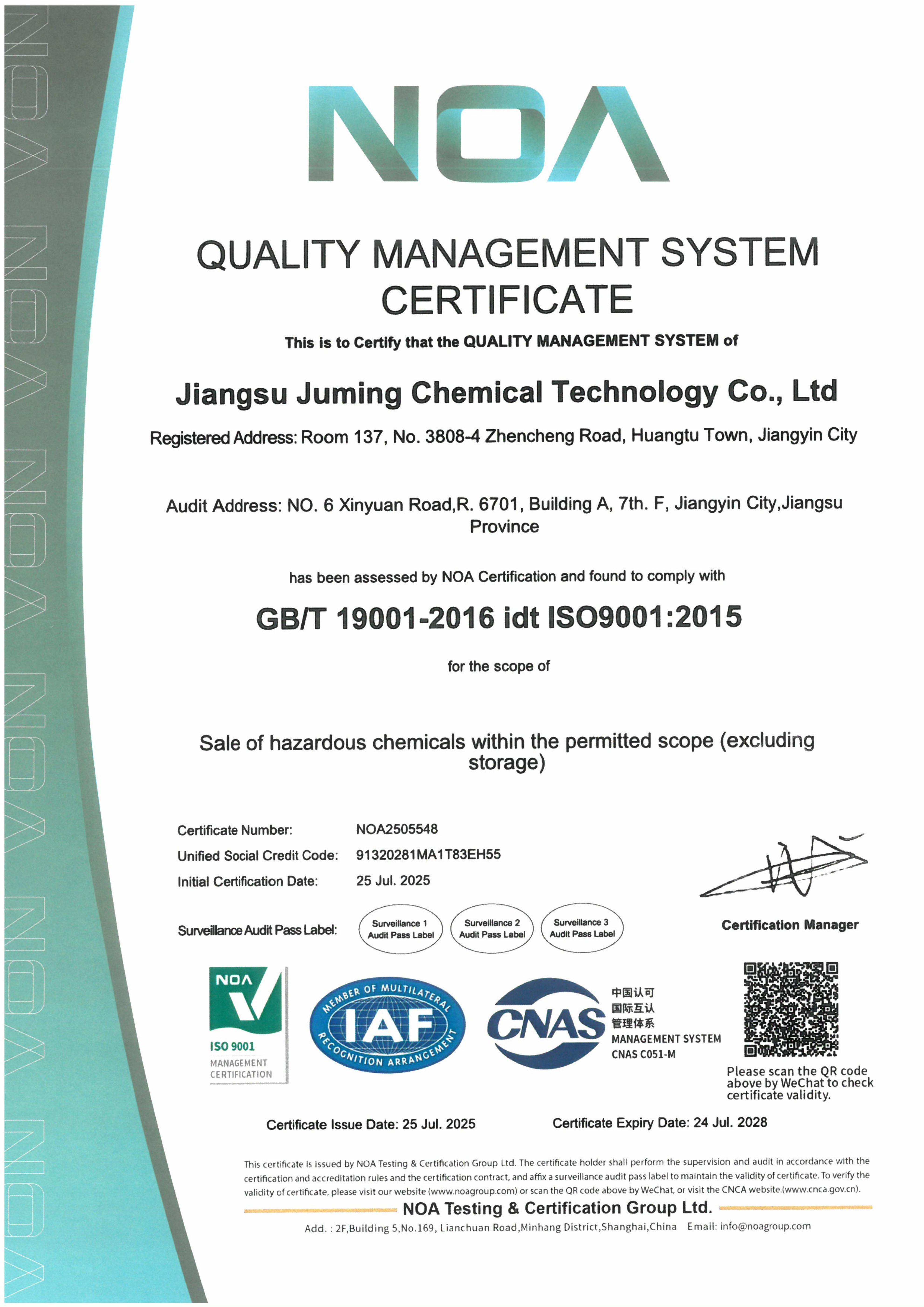
| ISO 9001 Quality Management System Certification | NOA2505548 | NOA Testing & Certification Group Ltd.; GB/T 19001-2016 idt ISO 9001:2015 | Sale of hazardous chemicals within the permitted scope (excluding storage) | Issued 25 July 2025; valid to 24 July 2028 |
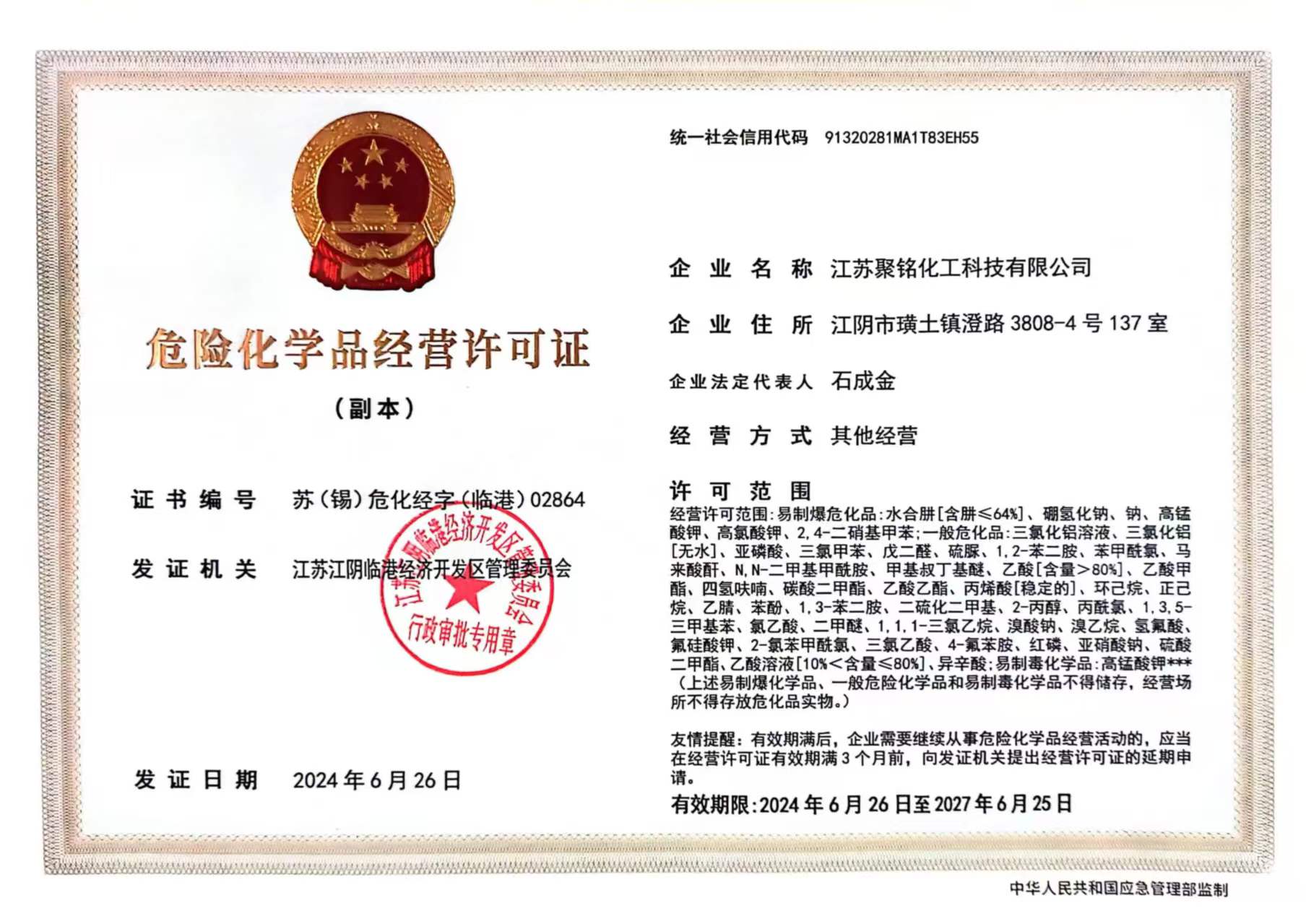
| Hazardous Chemicals Operation License | Su(Xi)WHJJZ(Lingang)02864 | Jiangsu Jiangyin Lingang Economic Development Zone Management Committee; Regulations on the Safety Management of Hazardous Chemicals | Sale of hazardous chemicals within the permitted scope (excluding storage) | Issued 26 June 2024; valid to 25 June 2027 |
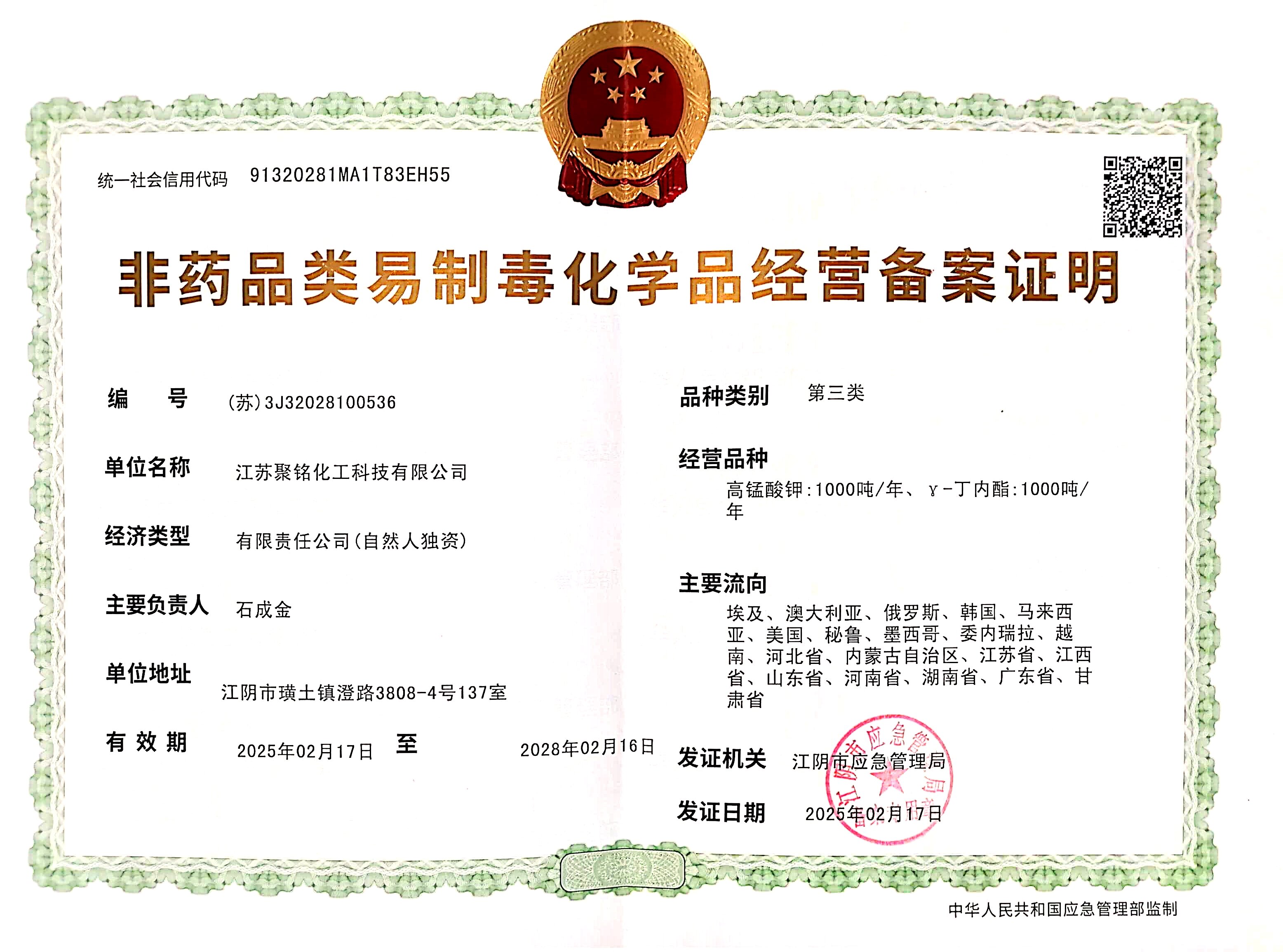
| Non-pharmaceutical Precursor Chemicals Filing Certificate | (Su) 3J32028100536 | Jiangyin City Emergency Management Bureau; Measures for the Administration of Filing of Non-pharmaceutical Precursor Chemicals Business | Business operation of Category III non-pharmaceutical precursor chemicals | Issued 17 February 2025; valid to 16 February 2028 |
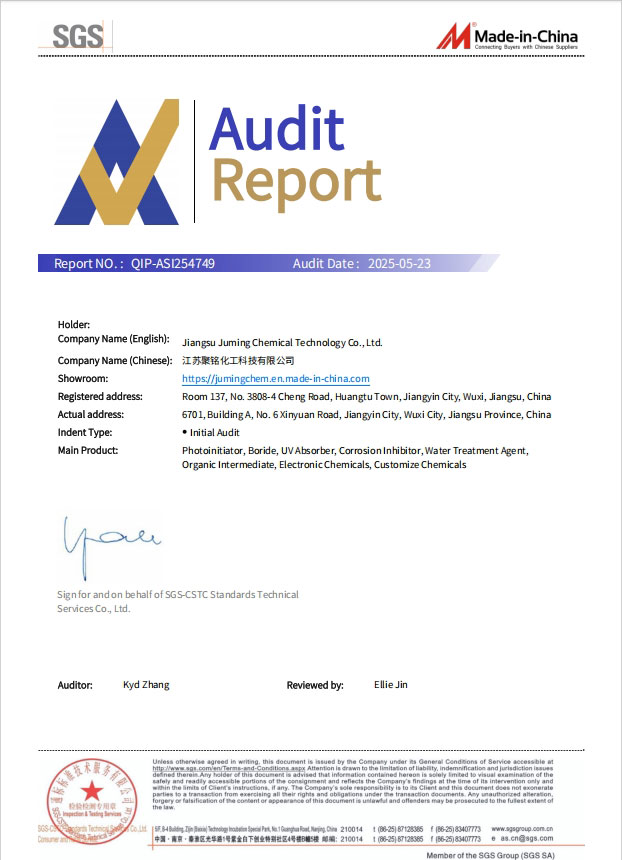
| SGS Factory Audit Report | QIP-ASI254749 | SGS; Made-in-China Supplier Initial Audit Standard | Photoinitiator, Boride, UV Absorber, Corrosion Inhibitor, Water Treatment Agent, Organic Intermediate, Electronic Chemicals, Customize Chemicals | Issued 23 May 2025 |
| RoHS Environmental Protection Compliance Certification | CKEYS250724006 | Guangdong KEYS Testing Technology Co., Ltd.; RoHS 2.0 Directive (EU) 2015/863 and (EU) 2017/2102 amending Annex II to Directive 2011/65/EU | Tolyltriazole | Issued 24 July 2025 |
Layer 2 — Substance-level certificates
- RoHS. As noted above, the recorded scope is Tolyltriazole. Request the certificate again if the substance changes.
- REACH compliance certification. In a documented European fine chemical trader case, the supplied products passed REACH compliance certification.
- Third-party test reports. Reports from SGS, BV or Intertek are available on request and should be issued against the same CAS number as the purchase order.
Layer 3 — Batch-level records
- A Certificate of Analysis (COA) issued for each shipment, with test items covering purity (GC/HPLC), moisture, appearance, colour, acid value and, for electronic grade, metal content. COA test items and format can be customised.
- MSDS in English, Spanish or another requested language.
- Custom label design carrying the client's brand and logo.
- Batch traceability coding system linking the drum to its production batch.
- Packaging integrity check on receipt, followed by COA review against the incoming material.
- Pre-shipment sample confirmation for new clients, with optional client pre-shipment inspection or third-party SGS/BV inspection.
Step-by-Step: Verifying a VBC Compliance File
Step 1 — Fix the identity before the quote
State the CAS number, the EINECS number and the isomer form on the RFQ. If the requirement is a blend rather than a single isomer, state the target ratio. Jumingchem's documented isomer capability covers pure para-isomer (≥99% p-VBC), pure ortho-isomer (≥98% o-VBC), pure meta-isomer (≥98% m-VBC) and any custom mixture ratio of o/m/p isomers. Without that definition, two quotes cannot be compared and neither can be verified on arrival.
Step 2 — Match every document to that identity
Check the CAS line on each certificate, COA and MSDS against the purchase order. Treat any document whose named substance differs as a different document, not as a close-enough substitute. Where a custom blend is supplied, confirm the supplier's documentation describes that blend rather than only the parent mixed grade.
Step 3 — Check scope, issuer and validity
For each document, read four fields: who issued it, which standard it references, what scope text it carries, and when it expires. An expired document is not evidence. The Layer 1 table above shows how these fields should be captured; a file that records only the certificate title and a PDF is not auditable.
Step 4 — Cross-check the COA against physical parameters
Appearance, boiling point, density, refractive index, melting point and storage temperature are measurable at goods-in and can falsify a mis-declared isomer or a substituted lot. The parameters below are those recorded for the Jumingchem VBC range.
| Parameter | 4-Vinylbenzyl chloride (1592-20-7) | 1-(chloromethyl)-2-vinylbenzene (22570-84-9) | 1-(chloromethyl)-3-vinylbenzene (39833-65-3) | Vinylbenzyl chloride (30030-25-2) |
|---|---|---|---|---|
| Appearance | Colourless to pale yellow transparent liquid | Light yellow to colourless liquid | Light yellow to colourless liquid | Light yellow to colourless liquid |
| Boiling point | 229 °C (lit.) | 223.4 ± 9.0 °C (predicted) | Not recorded in the supplied data | 229 °C (lit.) |
| Density | 1.083 g/mL at 25 °C (lit.) | 1.066 ± 0.06 g/cm³ (predicted) | Not recorded in the supplied data | 1.074 g/mL at 25 °C (lit.) |
| Melting point | Not recorded in the supplied data | Not recorded in the supplied data | Not recorded in the supplied data | −30 °C |
| Refractive index | n20/D 1.572 (lit.) | Not recorded in the supplied data | Not recorded in the supplied data | n20/D 1.572 (lit.) |
| Vapour pressure | 1 mm Hg (56.1 °C) | Not recorded in the supplied data | Not recorded in the supplied data | 1 mm Hg (56.1 °C) |
| Storage temperature | 2–8 °C | Not recorded in the supplied data | Not recorded in the supplied data | −20 °C |
| Stabilizer as recorded | Not specified in the supplied data | Not specified in the supplied data | ~0.1% TBC stabilizer | Contains 50–100 ppm TBC as inhibitor |
Step 5 — Confirm stabilizer content, storage and shipping conditions
Stabilizer content is a specification line, not an afterthought. In the recorded VBC range, the meta-isomer is described with approximately 0.1% TBC stabilizer, while the mixed grade is described as containing 50–100 ppm tert-butylcatechol. Storage temperatures also diverge: 4-VBC is recorded at 2–8 °C, whereas the mixed grade is recorded at −20 °C. That difference propagates directly into transport documentation — temperature-controlled packaging for long-distance shipping in hot climates, a temperature-controlled container option for sea freight, and UN-certified dangerous goods packaging available on request.
Handling requirements should also be reflected in the receiving procedure. The product must be handled under extremely dry and sealed conditions to prevent moisture-induced hydrolysis, and the polymerisation reaction is recommended to be carried out under inert gas protection in anhydrous polar solvents such as NMP or DMAc.
Step 6 — Map the file to the destination market
The final step is the one most often skipped: deciding which documents the destination market actually requires. A Chinese domestic authorization — the Hazardous Chemicals Operation License or the Non-pharmaceutical Precursor Chemicals Filing — evidences the supplier's legal ability to trade in China. It does not, by itself, demonstrate that a destination market accepts the product. Buyers in the United States, Korea, Japan, Taiwan region, Germany, Southeast Asia and the Middle East operate under different national requirements, and Jumingchem's recorded export markets span all of these. A documentation pack is therefore assembled per destination, not copied between them.
Where the European Union is the destination, the RoHS 2.0 Directive (EU) 2015/863 and (EU) 2017/2102 amending Annex II to Directive 2011/65/EU is one reference point, and REACH compliance certification is another — the latter being the item recorded as passed in the European distributor case. This guide does not restate any single jurisdiction's rules as a global standard, because no such global standard exists; import-specific legal advice remains the buyer's responsibility.
Application Context: Match the Documentation to the End Use
Different end uses place different demands on the same substance, and the documentation requested should follow the application rather than the catalogue page.
- High-performance negative photoresist resins, including electron-beam photoresists. Metal-ion control is normally the binding specification. In a documented photoresist developer project, metal impurities below 10 ppb were achieved, meeting SEMI Grade 4 standards.
- Advanced packaging dielectric materials. The same monomer is used in dielectric materials for advanced packaging, where metal and particle control carry into downstream electrical performance.
- Homogeneous ion-exchange membranes. Identity and isomer consistency matter because the monomer is polymerised into the membrane backbone.
- Ultra-pure water resins. Leachable metal content in the incoming monomer is a direct input to the finished resin specification.
- Chelating resins. Documented as a further application for the same VBC range.
VBC is described as a dual-functional monomer that can be derivatised by chloride displacement, and it can serve as a starter for various copolymer preparations. It can also be a component of ion exchange resins, photoresist polymers, cross-linkable fibres, coupling agents and electroconducting polymers — a breadth of downstream use that is itself a reason for strict substance naming on the inbound certificate.
Buyers specifying a related electronic-grade material face the same procedure. BPADA (CAS 38103-06-9, EINECS 253-781-7, C31H20O8, MW 520.49 g/mol) is the key synthetic monomer for high-performance polyimide, used in 5G high-frequency and high-speed flexible copper-clad laminate, OLED flexible substrates and lightweight aerospace composites. 5-Methyl-1H-benzotriazole (CAS 136-85-6, EINECS 205-265-8, C7H7N3, MW 133.15 g/mol) is used in semiconductor electronic materials as a corrosion inhibitor for copper and copper alloys and as an anti-fading agent in photomasking resins. Each carries its own CAS number, its own COA and its own certificate scope.
Comparison Table: Documented Profile by Product Family
| Product family | Registered identity | Documented application focus | Documented packaging options |
|---|---|---|---|
| VBC single isomers | 4-VBC 1592-20-7; 2-VBC 22570-84-9; 3-VBC 39833-65-3 | Core monomer for high-performance negative photoresist resins (including electron-beam photoresists), advanced packaging dielectric materials, homogeneous ion-exchange membranes, ultra-pure water resins, chelating resins | Liquid range: 25 kg HDPE drum, 200 kg steel-plastic composite drum, 1000 L IBC |
| VBC mixed grade | 30030-25-2 | Same downstream applications; supplied as a 3- and 4-isomer mixture containing 50–100 ppm TBC inhibitor | Liquid range: 25 kg HDPE drum, 200 kg steel-plastic composite drum, 1000 L IBC; temperature-controlled packaging for long-distance hot-climate shipping |
| BPADA | 38103-06-9 | Key synthetic monomer for high-performance polyimide, 5G high-frequency and high-speed FCCL, OLED flexible substrate, lightweight aerospace composites | Solid range: 25 kg fibre drum with PE liner, 25 kg kraft paper bag, 500 kg bulk bag |
| 5-Methyl-1H-benzotriazole | 136-85-6 | Semiconductor electronic materials — copper and copper alloy corrosion inhibition, anti-fading agent in photomasking resins; industrial water treatment and lubricant additive systems | Solid range: 25 kg fibre drum with PE liner, 25 kg kraft paper bag, 500 kg bulk bag |
Case Evidence: What a Verified Delivery Looks Like
Compliance claims become checkable when they are attached to a project outcome. The following figures are recorded against Jumingchem's electronic-chemicals projects across Korea, the United States, Japan, Taiwan region and Germany, with project durations of two to four years.
- Photoresist developer: metal impurities below 10 ppb, meeting SEMI Grade 4 standards; the client then passed verification by a top-tier Korean wafer fab and moved to mass production.
- OLED panel manufacturer: metal impurities below 20 ppb with particle control at ≤0.1 µm, associated with a 3% yield improvement in OLED panel production.
- Chip foundry: imported suppliers were replaced, with cost reduced by approximately 25% and delivery lead time shortened from 8 weeks to 4 weeks.
- European fine chemical trader: four consecutive years of cooperation and a 100% repurchase rate, with products passing REACH compliance certification.
- Supply scale: annual supply of 5 tons of ArF photoresist monomer, 8 tons of OLED intermediates and photoresist monomers, 3 tons of KrF photoresist monomer and PAG, plus 20 tons of annual procurement of photoinitiators and high-purity electronic additives.
- Process and documentation support: microchannel and continuous-flow technology for high-purity production with ppb-level purification; GMP cleanrooms with full-process ICP-MS monitoring; first validation sample delivered within 2 weeks; OEM customisation delivered within 6 weeks; 72-hour emergency order response mechanism; ISO 9001 and SGS certifications with complete export documentation and temperature-controlled logistics.

Frequently Asked Questions
1. Which certifications and documents should be verified before ordering electronic-grade vinylbenzyl chloride?
Verify three layers. The supplier layer covers ISO 9001 certificate NOA2505548 (issued 25 July 2025, valid to 24 July 2028), the Hazardous Chemicals Operation License Su(Xi)WHJJZ(Lingang)02864 (issued 26 June 2024, valid to 25 June 2027), the Non-pharmaceutical Precursor Chemicals Filing Certificate (Su) 3J32028100536 (issued 17 February 2025, valid to 16 February 2028) and the SGS Factory Audit Report QIP-ASI254749 (issued 23 May 2025). The substance layer covers certificates such as RoHS certification CKEYS250724006, whose recorded scope is Tolyltriazole, and third-party reports from SGS, BV or Intertek. The batch layer covers the COA issued for each shipment, together with the MSDS, batch traceability coding and, where required, pre-shipment or third-party inspection. Every document must carry the same CAS number as the purchase order, and every document must be inside its validity period.
2. Can a supplier provide custom electronic-grade chemicals as an OEM manufacturer?
Yes. Jumingchem provides customised OEM/ODM and full-chain CDMO services covering process R&D, pilot scale-up and commercial production, with a monthly capacity of 5,000 tons and an MOQ of 1 kg. Customisation is offered at four levels: molecular structure and synthesis route; purity grade, including electronic grade with metal impurities controlled below 10 ppb and metal-ion specifications adjusted to customer requirements; isomer composition, covering pure para-isomer (≥99% p-VBC), pure ortho-isomer (≥98% o-VBC), pure meta-isomer (≥98% m-VBC) and any custom o/m/p mixture ratio; and packaging, from 1 kg to tons. Documentation is also customisable — COA with client-specified test items and format, MSDS in English, Spanish or other languages, custom labels carrying the client's brand and logo, and third-party test reports from SGS, BV or Intertek. OEM customisation is delivered within 6 weeks, and the first validation sample within 2 weeks.
3. What drives the cost of electronic-grade VBC, and how should quotes be compared?
Cost is driven mainly by specification, not by product name. The variables are the isomer grade required (a pure para-isomer at ≥99% versus a mixed grade), the metal-impurity specification (electronic grade with ppb-level control requires more purification than industrial or high-purity grade), the documentation scope (custom COA test items, multilingual MSDS, custom labels, third-party testing), packaging type, order quantity against the 1 kg MOQ, and the logistics mode — 4-VBC is stored at 2–8 °C and the mixed grade at −20 °C, so temperature-controlled shipping is a real cost line. Quotes are therefore only comparable when the CAS number, isomer ratio, purity grade, metal specification, packaging and documentation list are identical across all of them. As a reference point, one documented chip foundry project reduced cost by approximately 25% and shortened lead time from 8 weeks to 4 weeks after supplier substitution.
4. How does sampling and pre-shipment confirmation work?
Sampling is available from an MOQ of 1 kg and is normally shipped by international express (DHL, FedEx or UPS) with a delivery time of 3–5 working days. For new clients, sample confirmation is available before mass production, and the first validation sample is delivered within 2 weeks. Each production batch is fully tested by factory QC, and a complete COA is issued for every shipment; optional pre-shipment inspection by the client or by a third party such as SGS or BV can be arranged. On receipt, the standard acceptance sequence is a packaging integrity check followed by COA review against the incoming material, with purity (GC/HPLC), moisture, appearance, colour, acid value and metal content as the core electronic-grade test items.
5. What are typical lead times and shipping options, and how does a buyer start?
Production lead time is 7–30 days depending on specification and quantity, and there is a 72-hour emergency order response mechanism for urgent requirements. Sea freight (FCL or LCL) ships from Shanghai or Ningbo in 15–35 days depending on destination, with a temperature-controlled container option available for VBC. Air freight takes 5–7 working days and suits urgent small orders of high-value, high-purity electronic-grade material. International express takes 3–5 working days for samples and small batches. Payment terms include T/T, D/P, Western Union and PayPal. To start, send the CAS number, isomer form, purity grade, metal-impurity specification, packaging preference and destination market, and request a quotation, a sample or the product catalogue; the full Jiangsu Juming catalogue can be downloaded here: Jiangsu Juming product catalogue (PDF).
Conclusion: Build the File Around the Substance, Not the Product Family
Electronic-grade chemicals compliance is a mapping exercise, and the map has to start from a single point: the registered identity of the substance being bought. For vinylbenzyl chloride that means choosing between CAS 1592-20-7, CAS 22570-84-9, CAS 39833-65-3 and CAS 30030-25-2 before the first quotation is issued, then holding every certificate, COA and data sheet to that same number. All four identities share the formula C9H9Cl and a molecular weight of 152.62 g/mol, so the formula alone will never separate them, and the physical parameters that do separate them — boiling point, density, melting point, storage temperature and stabilizer content — should be written into the goods-in test plan.
From there, three disciplines close the file. Check the scope text rather than the certificate title, because a RoHS certificate issued for Tolyltriazole does not cover a VBC isomer. Check the validity dates, because an expired authorization is not evidence. And check the destination market, because a Chinese domestic filing and a European directive reference answer different questions, and no single region's rules apply globally.
Request a VBC Documentation Pack, Sample or Quotation
Jiangsu Juming Chemical Technology Co., Ltd. (Jumingchem) supplies electronic-grade VBC isomers, BPADA and 5-methyl-1H-benzotriazole with per-batch COA, MSDS in multiple languages, batch traceability coding and third-party testing available on request.
Email: sales@jumingchem.com | Phone / WhatsApp: +86 159 6162 4309
Website: https://en.jmchemchina.com/ | Address: Jiangyin, Wuxi City, Jiangsu, China
Catalogue download: Jiangsu Juming catalogue (PDF)
This guide covers documentation and specification verification for electronic-grade chemicals. Import requirements are jurisdiction-specific and change over time; buyers should confirm current requirements for their destination market before shipment.
Have Questions or Need More Details?
Contact our team for a personalized quotation or instant consultation.
Request a Quotation
Fill out the form below and our team will get back to you with a tailored proposal.
WhatsApp Direct Chat
Prefer to chat in real-time? Message us on WhatsApp for instant assistance & quick answers.
- Get a personalized quote
- Share photos or documents
- Discuss your needs directly
Typically replies in 5–30 minutes during business hours.