Electronic-Grade BPADA: Certification Scope and Region Guide

Electronic-grade BPADA compliance is not a single checklist that can be applied worldwide. For 4,4'-(4,4'-isopropylidenediphenoxy)diphthalic anhydride, a document pack sent to a procurement or QA team usually answers four different questions at once: who the supplier is, which management system it runs, which substance a named certificate actually covers, and how the delivered batch was tested. A qualification decision goes wrong when those four answers are read as one.
This guide sets out how to separate them. It maps the documents a buyer is likely to receive from Jiangsu Juming Chemical Technology Co., Ltd. (Jumingchem) against the verified product identity of BPADA, explains what each document does and does not establish, and converts the regional question into six written requests that can be put to any supplier rather than one assumed global rulebook.
Why a compliance folder is not a compliance answer
The common failure mode in BPADA sourcing is a folder that looks complete. It contains an ISO 9001 certificate, an audit report, a RoHS document, a business licence and a filing record, so the file appears finished before anyone asks whether any of those items relates to the purchased substance. In practice, a general compliance folder mostly evidences the supplier as an entity, while the buyer's real exposure sits in the product specification and the batch record.
Two things make the gap wider for electronic-grade materials than for industrial grades. First, the grade itself is defined by numbers — assay, metal-ion limits, moisture, particle control — that a management-system certificate never contains. Second, the market the documents must satisfy is not one market. A document set that clears a domestic Chinese operating requirement and an EU import review are different sets, and a supplier cannot credibly claim one file covers both.
Step one is identity, not paperwork
Before scope can be assessed, the compliance subject has to be fixed. BPADA is listed by Jumingchem as 4,4'-(4,4'-isopropylidenediphenoxy)diphthalic anhydride, also described as bisphenol A dianhydride and historically indexed under trade names such as ULTEM dianhydride. Because several dianhydrides share the BPADA abbreviation in commercial catalogues and because synonyms vary between suppliers, the CAS number and molecular formula are the anchors that should appear on every document in the file.
| Parameter | Verified value |
|---|---|
| Product name | 4,4'-(4,4'-Isopropylidenediphenoxy)diphthalic anhydride |
| Common designation | BPADA; 4,4'-bisphenol A dianhydride |
| CAS number | 38103-06-9 |
| EINECS | 253-781-7 |
| Molecular formula | C31H20O8 |
| Molecular weight | 520.49 g/mol |
| Appearance / form | White to slightly yellow crystalline powder (powder to crystal) |
| Melting point | 184–187 °C (lit.) |
| Boiling point | 712.3 ± 60.0 °C (predicted) |
| Density | 1.406 ± 0.06 g/cm³ (predicted) |
| Vapour pressure | 0 Pa at 25 °C |
The annotations in that table are part of the compliance content, not a footnote. A melting point marked "(lit.)" is a literature value; a boiling point or density marked "(predicted)" is a calculated estimate rather than a measured result. When a supplier specification sheet quotes such values without their qualifiers, the qualifier has been lost in transcription, and the buyer can no longer tell which figures a laboratory actually measured. Ask for the qualifier to be restored before the specification is signed.
A second identity check is worth running on the supplier's own documentation. Every certificate, COA and packing list in the file should carry the same CAS number, the same product name in the same spelling, and the same grade designation. Where a document names a different compound, it belongs in a different file — a point that becomes concrete in the document review below.
Why electronic-grade BPADA attracts this level of scrutiny
BPADA is the key synthetic monomer for high-performance polyimide, for 5G high-frequency and high-speed flexible copper-clad laminate, for OLED flexible substrates and for aerospace lightweight composites. Its bisphenol A core gives polyimides high thermal stability and mechanical strength, and because films synthesised from this molecule are incompletely conjugated they also deliver high optical transparency, with a glass transition temperature reported at 207 °C. The same polyimides are chemically inert enough to serve as ion transport membranes in fuel cells, and BPADA is also used to produce superhydrophobic aerogels that exhibit the lotus effect.
Demand context supports the attention. Fortune Business Insights estimates the global photoresist chemicals market at USD 40.30 billion in 2026, up from USD 38.00 billion in 2025 and projected to reach USD 63.77 billion by 2034. Published estimates of this market differ in what they include — solvents and developers versus light-sensitive polymers — so the figure is background for demand, not a criterion in a supplier qualification.
The technical reason for the documentation burden is simpler than the market reason. BPADA contains active acid anhydride groups and is extremely sensitive to moisture. On contact with water it undergoes hydrolysis ring-opening to the corresponding diacid, which significantly reduces or destroys its polymerisation activity. A material that can degrade in storage is a material whose certificate has to describe moisture, packaging and storage conditions — not only purity.
How to read a certificate: five fields that decide its value
Any certificate in a BPADA file can be assessed in a fixed order, and the order matters because a strong answer to one field does not compensate for a missing answer to another.
- Scope. What exactly was assessed — an entity, a site, a management system, a product family, or one CAS number? Scope is the field most often skipped and the one that decides whether the document is relevant at all.
- Standard or rule. Which published standard, directive or audit scheme was applied? A certificate number without its standard cannot be benchmarked against a buyer's own requirement.
- Authority. Who issued it — an accredited certification body, a testing laboratory, or a regional administrative bureau? These issue different classes of evidence and are not interchangeable.
- Validity. Issue date and expiry date, read against today's date. An expired audit report is a historical record, not current assurance.
- Substance link. Does the document name the CAS number being purchased? If it does not, the buyer is inferring a connection that the document never made.
Applied consistently, those five fields convert a mixed folder into a ranked evidence set, with product-level test data at the top and entity-level licences at the bottom.
Comparison: what the supplied compliance records establish
The records Jumingchem supplies are a useful worked example precisely because they are ordinary. Each is genuine and each is relevant to something; none of them is a BPADA product certificate.
| Record | Issuing body and reference | Scope as recorded | Validity | What it does not establish |
|---|---|---|---|---|
| ISO 9001 Quality Management System Certification | NOA Testing & Certification Group Ltd. — NOA2505548; GB/T 19001-2016 idt ISO 9001:2015 | Sale of hazardous chemicals within the permitted scope (excluding storage) | Issued 2025-07-25; valid to 2028-07-24 | No BPADA assay, metal-ion limit, moisture limit or test method |
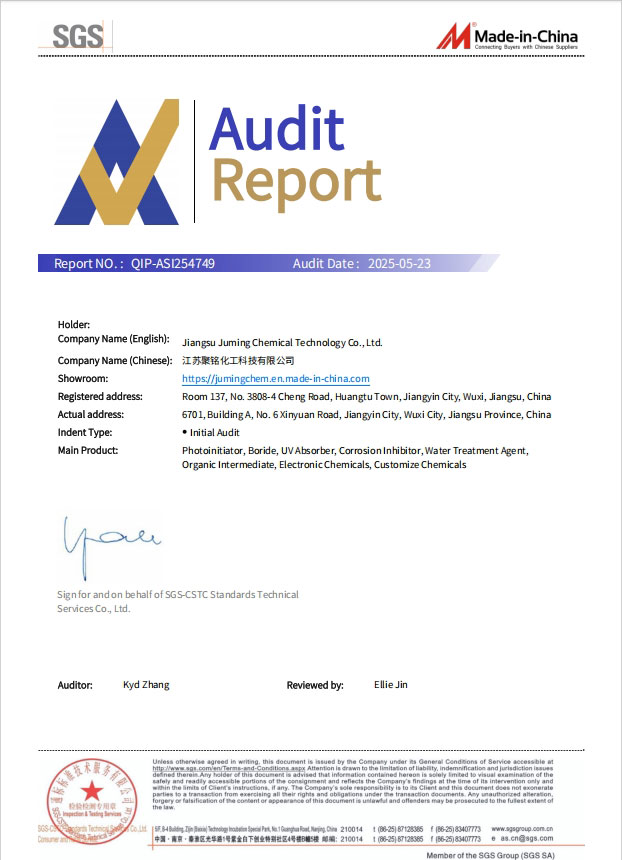
| SGS Factory Audit Report | SGS — QIP-ASI254749; Made-in-China Supplier Initial Audit Standard | Photoinitiator, boride, UV absorber, corrosion inhibitor, water treatment agent, organic intermediate, electronic chemicals, customised chemicals | Issued 2025-05-23; recorded expiry 2026-05-23 | Point-in-time capability audit, not a batch test; the recorded validity window has closed, so a current version should be requested |
| RoHS Environmental Protection Compliance Certification | Guangdong KEYS Testing Technology Co., Ltd. — CKEYS250724006; RoHS 2.0 Directive (EU) 2015/863 and (EU) 2017/2102 amending Annex II to Directive 2011/65/EU | Tolyltriazole | Issued 2025-07-24 | Scoped to a different product; says nothing about BPADA restricted-substance status |
| Hazardous Chemicals Operation License | Jiangsu Jiangyin Lingang Economic Development Zone Management Committee — Su(Xi)WHJJZ(Lingang)02864; Regulations on the Safety Management of Hazardous Chemicals | Sale of hazardous chemicals within the permitted scope (excluding storage) | Issued 2024-06-26; valid to 2027-06-25 | A business-operation licence, not a quality or purity document |
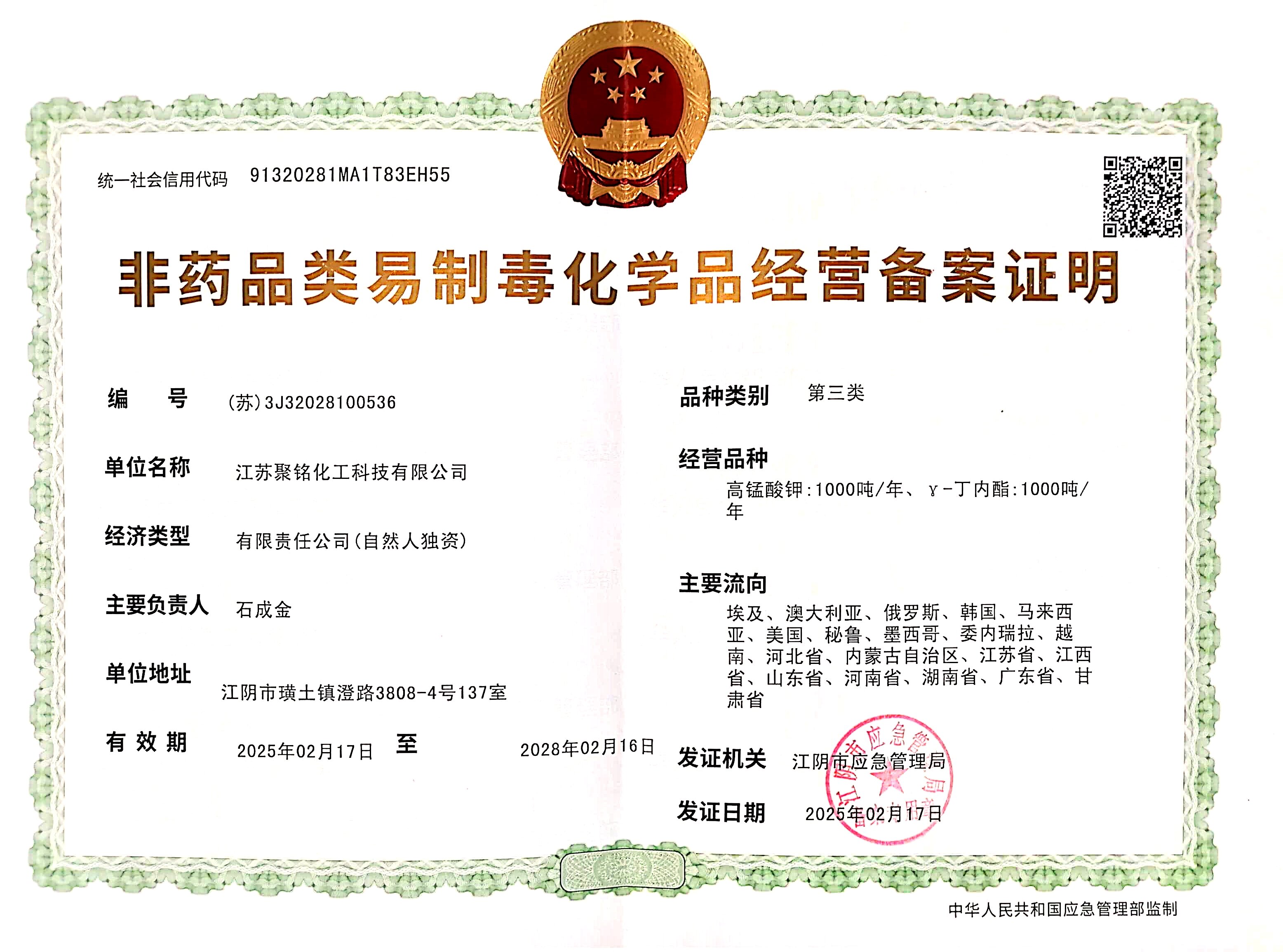
| Non-pharmaceutical Precursor Chemicals Filing Certificate | Jiangyin City Emergency Management Bureau — (Su) 3J32028100536; Measures for the Administration of Filing of Non-pharmaceutical Precursor Chemicals Business | Business operation of Category III non-pharmaceutical precursor chemicals | Issued 2025-02-17; valid to 2028-02-16 | A domestic Chinese filing record, not an import authorisation for any destination market |
Read together, these five records show that the supplier is a licensed, registered operating entity with a certified quality management system and one completed third-party factory audit. That is a legitimate screening outcome. None of the five states a BPADA grade, so none can be used to release a BPADA shipment.
Two entries deserve particular attention because they show how easily scope is misread. The RoHS certificate carries a real directive reference and a real test-laboratory issuer, yet its recorded scope is Tolyltriazole, a different product; presenting it in a BPADA file would mislead a reviewer who reads only the certificate title. The ISO 9001 certificate carries a recorded scope of "sale of hazardous chemicals within the permitted scope (excluding storage)" — a sales-scope certificate describing a management system, which is valuable for supplier governance and silent on product quality.
Standards alignment: match the standard to the question asked
Standards alignment fails most often because a buyer uses a management-system standard to answer a product question. Three common cases illustrate the mismatch.
ISO 9001 is a system standard. GB/T 19001-2016 idt ISO 9001:2015 certifies how a quality management system is operated. It is evidence that testing, deviation handling and traceability are controlled processes; it is not evidence that any particular BPADA batch met a particular number.
RoHS is a restricted-substance framework for electrical and electronic equipment. A RoHS declaration is meaningful when it is scoped to the substance actually being purchased and is supported by a test report on that CAS number. A RoHS certificate covering a different compound is not transferable, and a RoHS declaration on a chemical intermediate is not a purity grade.
Electronic grade is a specification, not a certificate. The grade exists only when the following are stated with limits and methods: assay, metal-ion content by named elements (for example Na, Fe and Cu), moisture, particle or filtration limits, and appearance against the white to slightly yellow crystalline powder description. Jumingchem lists electronic grade with ppb-level metal-ion control and offers metal-impurity specification as a customisation option, with a sub-10 ppb target available on request. Because that is a customisable target rather than a universal release limit, it has to be written into the purchase order as a number with a specified test method — otherwise two quotations described as "electronic grade" may not describe the same material.
Moisture belongs in that list for a functional reason. Since the anhydride ring opens on contact with water to form a diacid and lose polymerisation activity, a moisture limit protects the property the buyer is paying for. The same logic applies to packaging: Jumingchem supplies BPADA in 25 kg fibre drums with a PE liner, 25 kg kraft paper bags or 500 kg bulk bags, and the choice has to match the receiving site's dispensing and storage arrangements, not only the freight budget.
Regional documentation: six question groups, not one checklist
Because no single global checklist exists for a specialty dianhydride, the practical approach is to convert the region into written questions and require a documented answer to each. The six groups below cover what a BPADA qualification file normally has to demonstrate.
1. Substance inventory status
Ask which chemical inventory applies in the destination market and whether CAS 38103-06-9 is listed, with the reference. For the EU the relevant framework is REACH; for the United States it is the TSCA inventory; for Japan, Korea and Taiwan region the applicable national inventory should be named explicitly by the supplier or importer. A written inventory confirmation with a reference is a different class of evidence from a marketing statement that a product "is compliant".
2. Transport and dangerous goods classification
Ask whether the substance is classified for transport and, if so, for the UN number, proper shipping name, class and packing group taken from the current safety data sheet. Jumingchem lists UN-certified dangerous goods packaging as available on request, which is only useful once the classification question has been answered.
3. Safety data sheet and labelling
Ask for a safety data sheet in the language required by the destination market and for the label artwork that will be applied. Jumingchem lists MSDS in English, Spanish or other languages as a documentation option, together with custom label design — both of which should be specified in the technical agreement rather than requested after shipment.
4. Restricted-substance declarations scoped to the CAS number
Ask for any restricted-substance declaration to be issued against CAS 38103-06-9 with the supporting test report attached. Because the RoHS record in the supplied file is scoped to Tolyltriazole, a BPADA-specific declaration has to be requested separately; a reviewer who accepts the existing document in its place has accepted a scope mismatch.
5. Import control and precursor status
Distinguish domestic operating permissions from destination-market import requirements. The Chinese hazardous chemicals operation licence and the non-pharmaceutical precursor filing in the file tell an overseas buyer that the supplier holds the required Chinese operating permissions within their recorded scopes. They are not import authorisations, registrations or permits issued by any other jurisdiction, and should never be read as such.
6. Quality-system and audit evidence, current and site-specific
Ask for the current ISO 9001 certificate with its scope text, and for the most recent audit report with its validity window. Where the recorded expiry has passed, request the renewal or a fresh audit rather than treating the historical report as live assurance.
Each answer should be filed against the question it answers. A regional file assembled this way stays auditable: every claim has a document, every document has a scope, and every scope has a date.
A step-by-step document review workflow for BPADA qualification
The workflow below can be run by a procurement team with QA support and does not require the supplier's cooperation beyond normal document handling.
- Lock the identity. Confirm that CAS 38103-06-9, C31H20O8, MW 520.49 g/mol and EINECS 253-781-7 appear consistently on the quotation, the specification, the COA and the packing list. Reject any document that names a different compound, even if the product title looks correct.
- Turn the grade into numbers. Write the required assay, metal-ion elements and limits, moisture, particle or filtration limits, appearance range and test methods into a single specification. Anything described only as "electronic grade" is not yet a specification.
- Build the document set. Request the specification sheet, a redacted example COA, the current safety data sheet, the quality-system certificate with scope text, the latest audit report, and the regional answers from the six groups above.
- Test scope and validity. Apply the five-field reading to every item. Mark each document as entity-level, system-level, substance-level or batch-level, and check issue and expiry dates against today.
- Reconcile third-party listings against manufacturer data. Public catalogue pages for CAS 38103-06-9 do not always match supplier documentation; a figure such as a 99.5% typical assay quoted on a distributor listing is a catalogue value, not a batch release result, and the same is true of any appearance description. Reconcile every number back to the manufacturer's own specification and COA.
- Verify with an independent sample. Order a pre-shipment sample at the agreed grade and test it against your own criteria. Jumingchem lists 100% testing, batch traceability coding, retained samples and third-party re-inspection through SGS, BV or Intertek; a buyer can use those mechanisms directly by requesting a retained sample or an independent report on the delivered lot.
- Fix packaging and storage. Confirm the moisture-proof packaging format, the container size, and the storage instruction that the material must be kept absolutely dry and sealed, with polymerisation conducted under inert gas in an anhydrous polar solvent such as NMP or DMAc. A supplier who cannot state this has not understood the material.
- Put the acceptance criteria in the purchase order. The specification, the sampling plan, the document set to be delivered with each lot, and the retention period for retained samples all belong in the commercial document, not in an email thread.
Where the documentation lands in practice
Transparent polyimide films. Because films synthesised from BPADA are incompletely conjugated, they deliver high optical transparency alongside a glass transition temperature of 207 °C, which is why they are used as flexible display substrates, in 5G high-frequency and high-speed flexible copper-clad laminate, and in OLED flexible substrates. For this application the appearance range and metal-ion limits are functional, not cosmetic: colour variation and trace metal content are exactly what a transparency specification is trying to control. A buyer qualifying BPADA for a film line should therefore ask for appearance and metal-ion data on the same COA, from the same lot.
Superhydrophobic aerogels. BPADA can also be used to produce aerogels that are superhydrophobic and exhibit the lotus effect. Here the documentation question shifts towards consistency: surface behaviour depends on chemistry that is sensitive to moisture ingress, so the moisture specification, the packaging format and the storage condition carry more weight than a certificate title. A batch that absorbed water in transit has changed chemically before it reaches the reactor.
Ion transport and high-temperature parts. Polyimides from this monomer are chemically inert and heat resistant enough for ion transport membranes in fuel cells and for aerospace lightweight composites. In these uses, traceability matters as much as the number itself: a pilot run that cannot be traced to a retained sample cannot be reproduced, and a specification that cannot be reproduced is not a specification.
Frequently asked questions
Does an ISO 9001 certificate prove that BPADA meets an electronic-grade specification?
No. ISO 9001 certifies a quality management system. Jumingchem's certificate NOA2505548 records a scope of "sale of hazardous chemicals within the permitted scope (excluding storage)" against GB/T 19001-2016 idt ISO 9001:2015, valid to 2028-07-24. It shows that testing, traceability and deviation handling are governed; it does not state a BPADA assay, metal-ion limit or moisture limit. The product grade is established by the specification sheet plus a batch COA that reports results against stated limits and methods.
Which document in a supplier file should actually state the BPADA grade?
The product specification defines the grade; the certificate of analysis reports one batch against it. Certificates, licences and audit reports sit outside that chain. A BPADA specification should name CAS 38103-06-9, molecular formula C31H20O8, molecular weight 520.49 g/mol, appearance as white to slightly yellow crystalline powder, and then the numeric limits that matter to your process — assay, metal ions by element, moisture, particles. If the grade is described only in words such as "electronic grade", the specification is incomplete.
What does COA traceability mean when qualifying high-purity electronic-grade chemicals suppliers?
Traceable COA data links a specific lot to a specific specification and a specific test method. In practice that means the report carries a batch or lot number, states the specification limit beside each result, names the analytical method, records the release date, and can be reconciled against a retained sample or an independent re-test. Jumingchem's stated control model includes 100% testing, batch traceability coding, retained samples and third-party re-inspection through SGS, BV or Intertek. Before placing a first order, ask for a redacted example COA and check that all five elements are present; a COA listing results without limits or methods cannot be audited.
What regional documents should be requested for BPADA, and in what form?
Ask for written answers, each with a reference, in six groups: inventory listing status for CAS 38103-06-9 in the destination market; transport classification from the current safety data sheet; a safety data sheet in the required local language; restricted-substance declarations scoped to the CAS number with the supporting test report; confirmation of which Chinese domestic permissions the supplier holds, without treating them as import authorisations elsewhere; and current quality-system and audit evidence with scope and expiry. Ask also for the qualification answers in the same format for any alternative grade you are evaluating, so the files can be compared line by line.
What drives the price of electronic-grade BPADA?
Jumingchem does not publish BPADA pricing; quotations are issued against a grade and a packaging configuration. The commercial terms that are published include a minimum order quantity from 1 kg, lead times of 7–30 days, and packaging from 25 kg fibre drums with PE liner through 25 kg kraft paper bags to 500 kg bulk bags. Offers for the same CAS number diverge mainly because the underlying specifications differ — metal-impurity limit, moisture limit, particle or filtration requirement, test scope and packaging. Compare quotations only after the specification has been fixed, otherwise the cheaper offer may simply be a narrower specification.
How should a qualification sample be evaluated before a first order?
Order the sample at the exact grade written into the specification and test it against your own criteria rather than the supplier's: confirm identity, measure assay, check metal ions and moisture, and compare appearance with the white to slightly yellow crystalline powder description. Keep the sample COA and the retained portion. Jumingchem lists pre-shipment sample confirmation as a service and accepts orders from 1 kg, which is enough material to run a screening evaluation before committing to a production quantity.
What lead time and packaging should be planned around?
Jumingchem lists lead times of 7–30 days from order, with MOQ from 1 kg and a monthly capacity figure of 5,000 tons across its product range. BPADA is a moisture-sensitive solid, so specify moisture-proof packaging, confirm the container format against your dispensing setup, and plan storage as absolutely dry and sealed. If your site repackages material, agree the repacking condition with the supplier in advance. If you would like the document set discussed in this guide applied to a specific grade, the starting point is a specification and a sample request rather than a general enquiry.
Conclusion
Compliance for electronic-grade BPADA is decided by scope, not by volume of paperwork. A supplier file becomes usable when the buyer separates entity-level records such as the hazardous chemicals operation licence and the precursor filing, system-level records such as the ISO 9001 certificate and the SGS audit, substance-level records such as a CAS-scoped declaration, and batch-level records such as the COA. Jumingchem's own records show why the distinction matters: a genuine RoHS certificate scoped to Tolyltriazole, a management-system certificate scoped to chemical sales, and an audit report whose recorded validity window has closed are all legitimate documents that cannot release a BPADA lot.
The regional question follows the same logic. Instead of looking for one global checklist, convert each market into written questions about inventory status, transport classification, safety data sheet language, restricted-substance scope, import control and current quality-system evidence — then file the answers. Applied to a specification that names CAS 38103-06-9, C31H20O8, MW 520.49 g/mol, the white to slightly yellow crystalline powder appearance, melting point 184–187 °C and the moisture limit that protects the anhydride ring, that file supports a real qualification decision rather than the appearance of one.
Next step
Request the BPADA specification sheet together with a redacted example COA and a pre-shipment sample, so the document review and the laboratory evaluation can run in parallel.
Company profile and full product catalogue: Jiangsu Juming catalogue (PDF)
Have Questions or Need More Details?
Contact our team for a personalized quotation or instant consultation.
Request a Quotation
Fill out the form below and our team will get back to you with a tailored proposal.
WhatsApp Direct Chat
Prefer to chat in real-time? Message us on WhatsApp for instant assistance & quick answers.
- Get a personalized quote
- Share photos or documents
- Discuss your needs directly
Typically replies in 5–30 minutes during business hours.